Timebars Feature List
Multi-Project Timescale Canvas
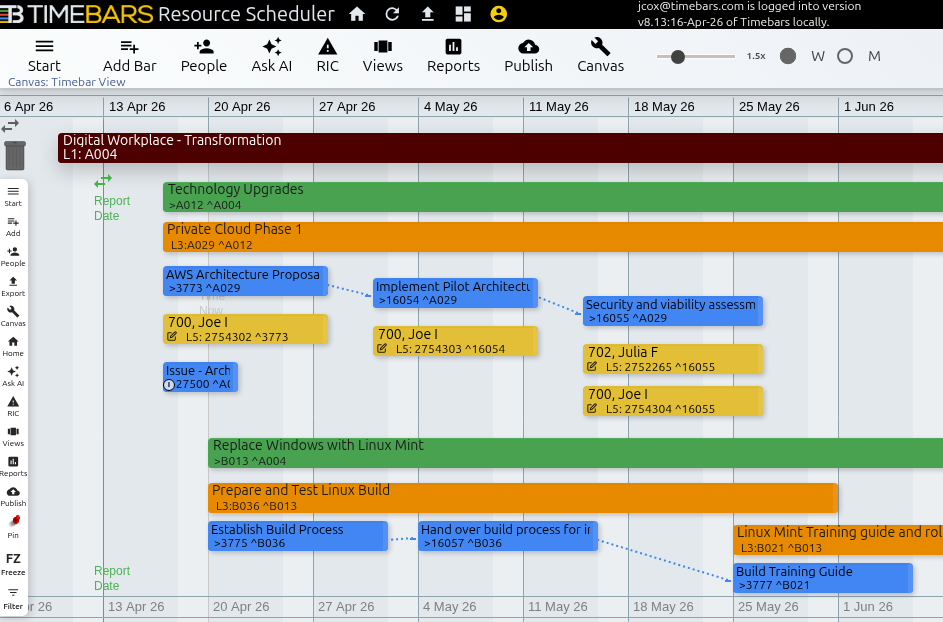
The Timebars canvas is the command centre for your entire project portfolio. Every project sits on a single scrollable timeline — brown bars for portfolio groupings, green bars for projects, blue bars for tasks and work packages. Scroll left and right to move through time, zoom in for day-level detail, or zoom out for a quarter-level portfolio view. All projects share the same canvas, so you see the full picture without switching files.
The Filter Menu lets you isolate specific projects, resources, or metadata values when the full portfolio view is too dense. Collapse it with the FM tab to reclaim canvas space, bring it back whenever you need to navigate. This is the view most project managers have open all day.
Your entire portfolio in one window.
Drag-and-Drop Bar Creator & Project Hierarchy
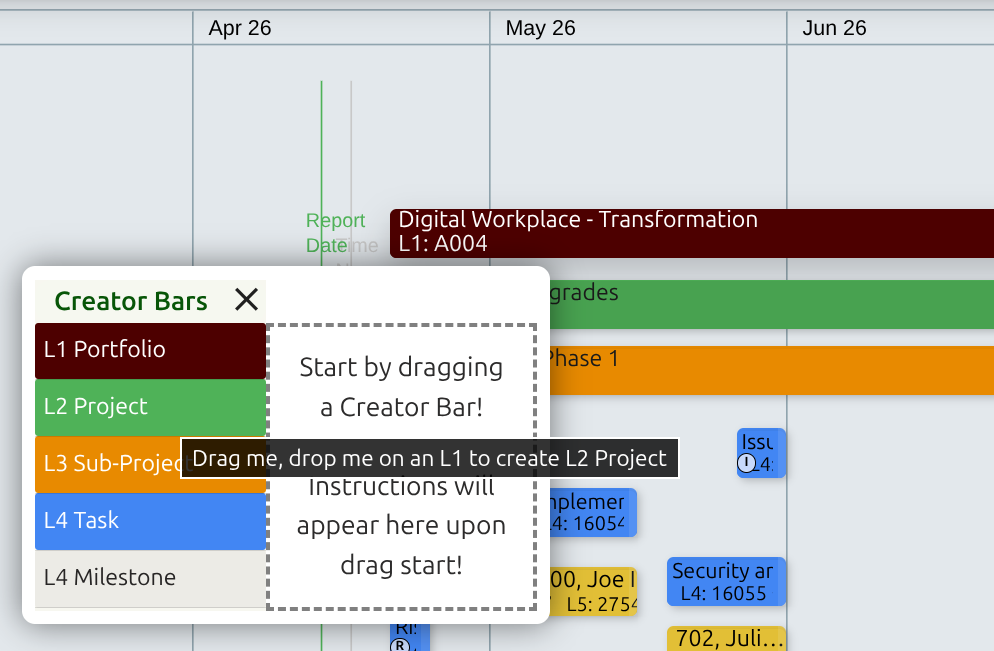
Create projects, work packages, tasks, and milestones by dragging a creator bar from the panel and dropping it onto the canvas. Drop a project creator onto empty space and a green project bar appears. Drop a task creator onto the project bar and a blue task is created underneath it, automatically linked to the right parent. Timebars enforces a clean hierarchy — projects contain work packages, work packages contain tasks — without requiring you to navigate any menus.
Duplicate, delete, or bulk-move bars with right-click options. Pin a constraint onto any bar to freeze its start or finish date, overriding automatic dependency adjustments when a deadline is non-negotiable. For large project structures the spreadsheet import is faster, but the creator is always available for quick additions and adjustments during planning sessions.
Build any project structure in minutes.
Task Dependencies & Smart Scheduling
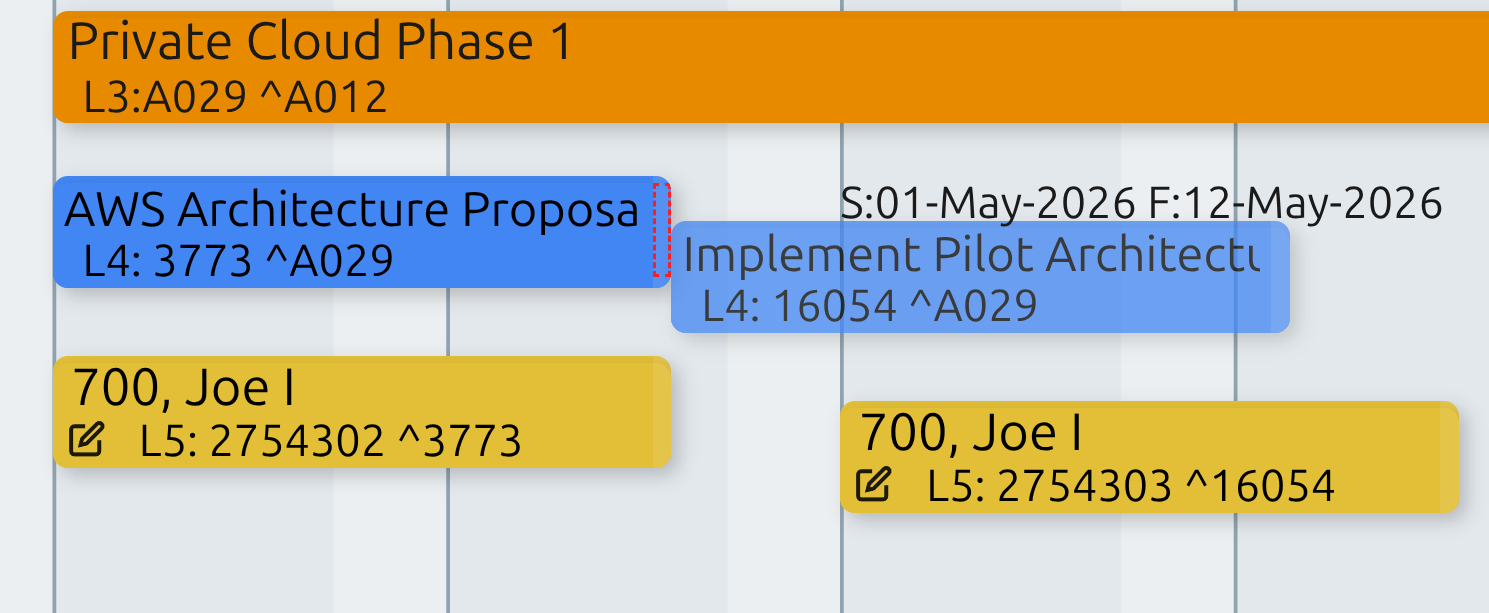
Create finish-to-start relationships between tasks by dragging one bar onto another. The Timebars scheduling engine maintains these dependencies automatically — move a predecessor and every downstream successor adjusts its start date accordingly. Dependency lines are displayed on the canvas so the chain of logic is always visible, and you can delete a relationship just as easily as you created it.
When automatic adjustment is not what you want, apply a constraint to pin a task in place. Constraints override the dependency engine for that task only, leaving the rest of the chain intact. This gives you both the efficiency of automatic scheduling and the control to handle fixed milestones, external deadlines, and contractual dates.
Scheduling logic that does the heavy lifting.
Resource Allocation & Cost Calculation
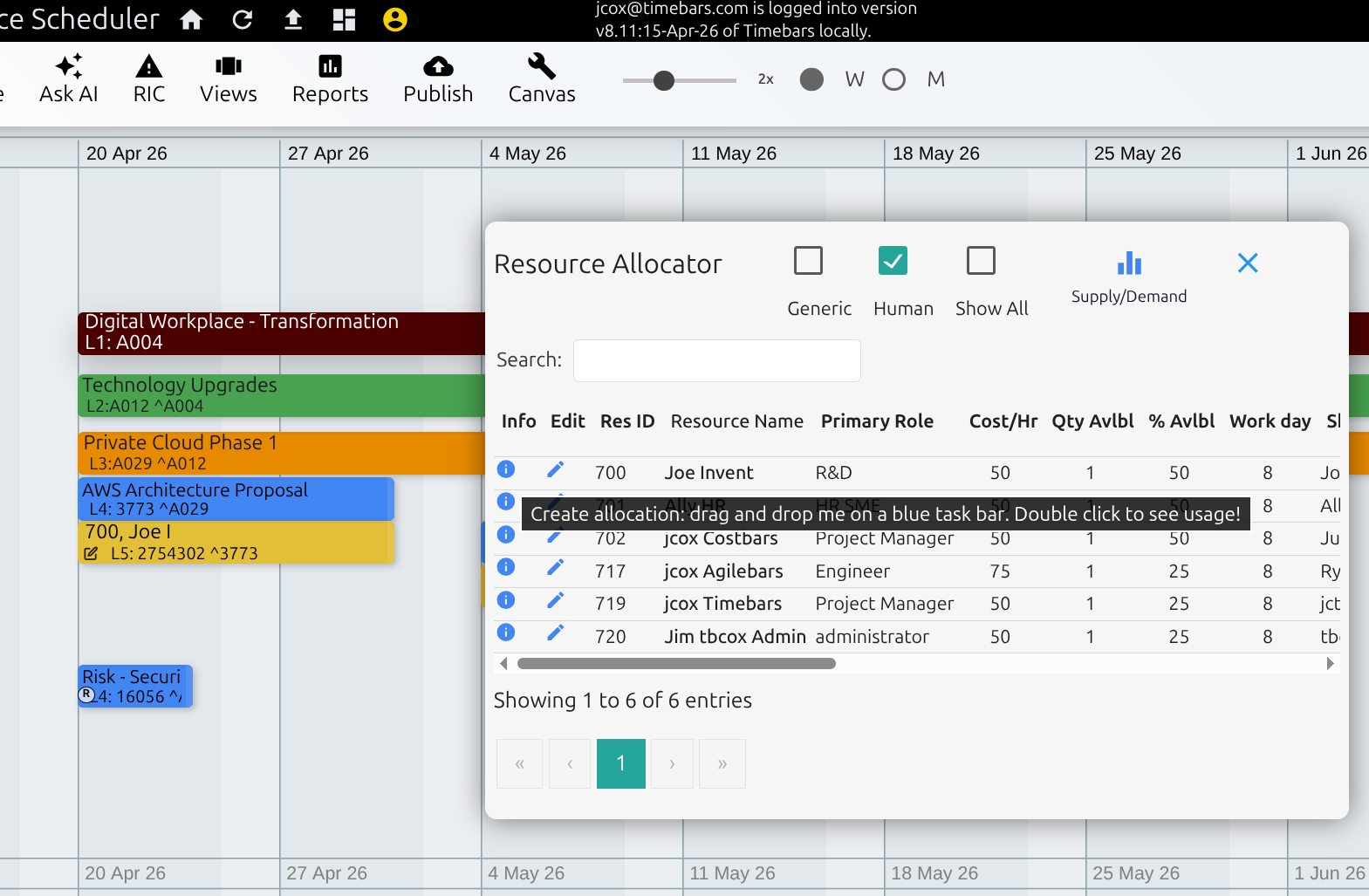
Open the Resource Allocator for any task and assign one or more resources from your centralised resource pool. Timebars calculates work hours and cost automatically based on the task duration and the resource's configured rate. Allocations are visible directly on the task bar so you can see who owns what at a glance without opening any forms.
Costs and hours roll up automatically from tasks to work packages to projects, giving you real-time budget visibility at every level of the hierarchy. Adjust an allocation and the rolled-up totals update immediately — no spreadsheet required to track whether a project is heading over budget.
Assign resources and costs update themselves.
Resource Availability View
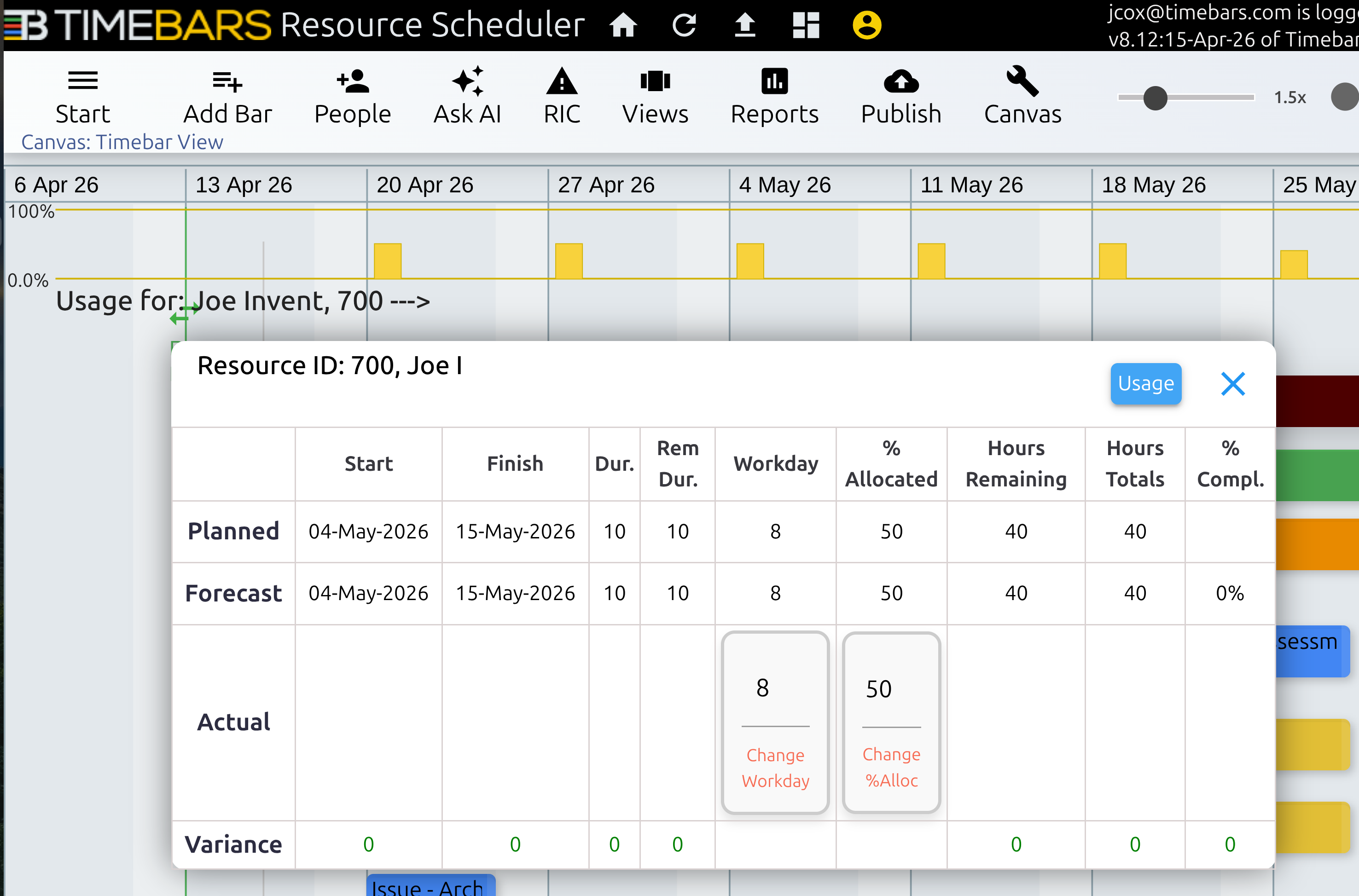
Double-click any resource name on the canvas to open their availability timeline. Weekly allocation percentages are displayed directly on the bars for that resource, making it immediately obvious where they are over-committed and where they have capacity to spare. Colour-coded indicators highlight utilisation bands — green for healthy, amber for near capacity, red for overallocated.
This view is invaluable when a new project is being scoped and you need to know quickly whether key people are available. See the current commitments across all active projects, identify the window when they are free, and schedule new work accordingly — without having to interrogate individual project files.
Know who is available before you commit them.
Resource Demand Charts
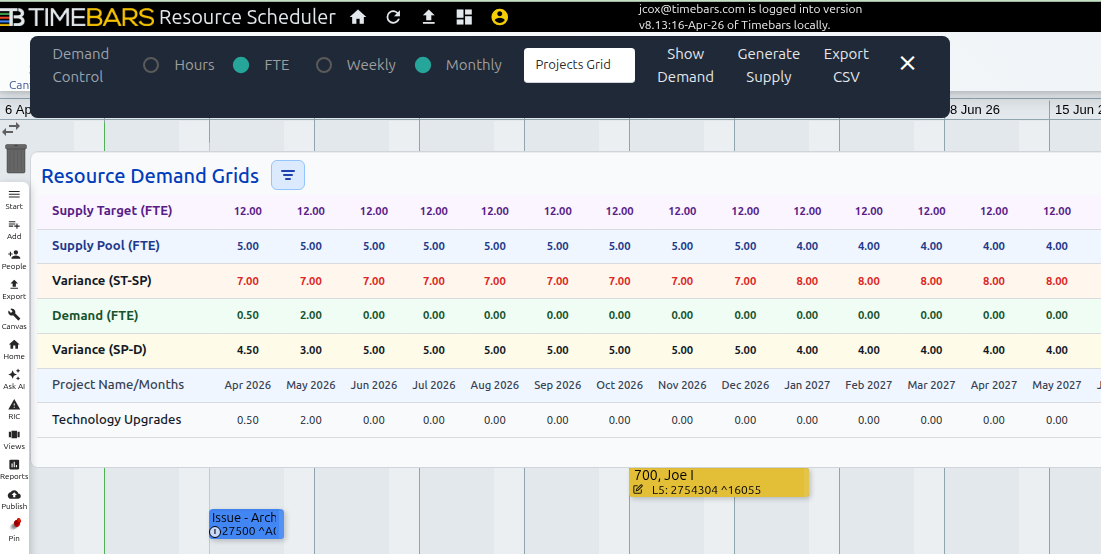
The demand grid provides a time-phased, aggregated view of resource supply versus demand across the entire portfolio. Each row represents a resource, role, skill group, or custom attribute. Each column is a time period. The cells show how much of that resource's capacity is consumed in that period — and whether supply is sufficient to meet demand.
This is the view that helps resource managers make decisions: where are the bottlenecks three months from now? Which skills are permanently over-committed? Which periods have slack that could absorb new project scope? The demand chart answers these questions in seconds rather than requiring manual consolidation of project data from multiple files.
Spot capacity bottlenecks months before they arrive.
Progress Tracking & Baselines
Update task progress by dragging the completion indicator on any bar, or entering a percentage directly in the core form. Progress rolls up automatically to work packages and projects — no manual recalculation. Actual start and finish dates are captured as soon as work begins and ends, so the schedule record is always up to date.
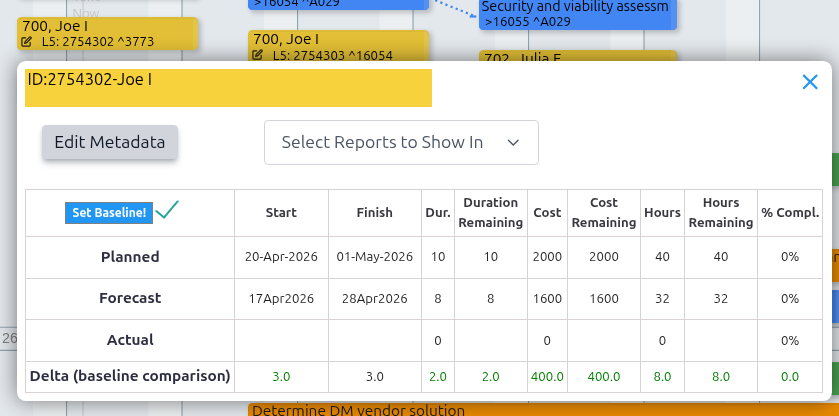
Set a baseline with a single click to snapshot the plan at any point in the project lifecycle. Timebars stores the planned dates and durations alongside the current forecast, making schedule variance immediately visible on the canvas. Set as many baselines as you need — at contract award, after each phase gate, or at each monthly review — and compare them at any time to document how the project evolved.
Know exactly how your plan has changed and why.
Risks, Issues & Change Requests
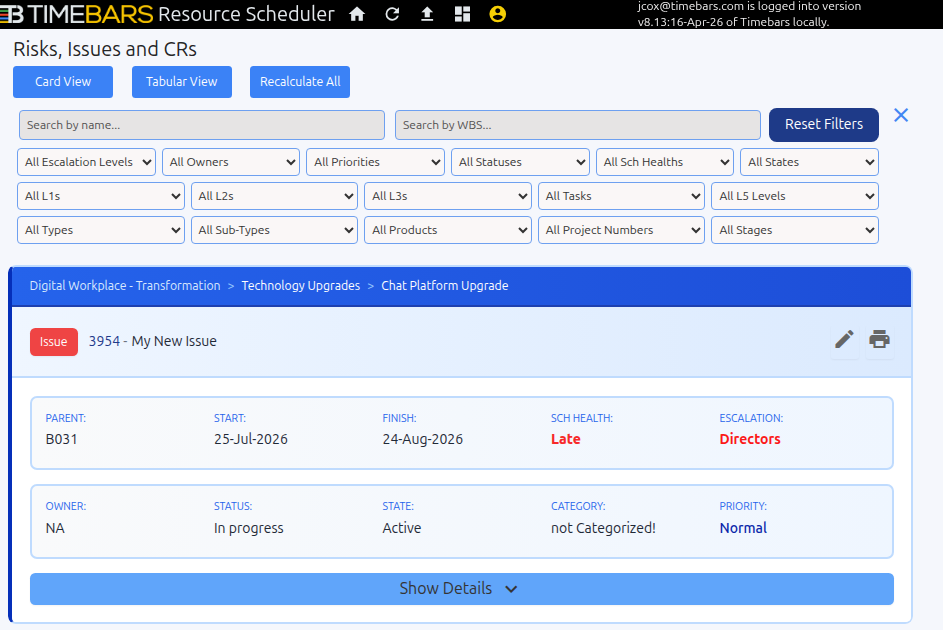
Convert any task to a Risk or Issue by changing its sub-type in the core form. Timebars immediately applies colour-coding based on severity — critical risks appear in red on the canvas — and prefixes the label so risk items are unmistakable even in a dense project view. Each risk or issue has a full form for owner, description, mitigation steps, probability, impact, and resolution notes.
Change requests follow the same pattern: raise a change item, link it to the affected tasks, record the scope and cost impact, and document the approval decision through the FOCD form system. The full audit trail — from original baseline to approved changes to revised plan — is maintained within the tool, giving you everything you need for governance reporting.
Risk and change management on the same canvas as the plan.
Core Report & Metadata Form
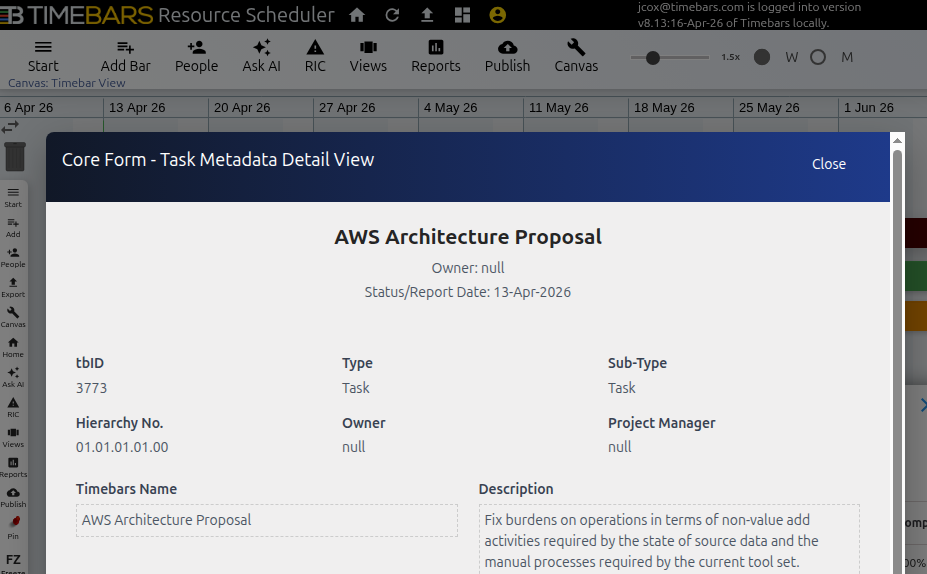
Click any bar's ID to open its Core Report — a full-detail form showing every attribute associated with that task: name, description, owner, status, actual dates, progress, resource allocations, cost data, custom metadata, and more. Edit directly from the form without leaving your current view. The form adapts to the bar type — project bars show portfolio-level fields, task bars show assignment and progress fields.
Custom metadata fields are driven by the Tags Table you define in the spreadsheet template. Picklists for Owner, Status, Priority, Phase, and any other fields your organisation uses are consistent throughout the app — data entered via the form, the spreadsheet, or the canvas all feed the same record, eliminating the duplicate-entry problem that plagues most project management setups.
Every detail, one click away from the canvas.
Spreadsheet Synchronisation
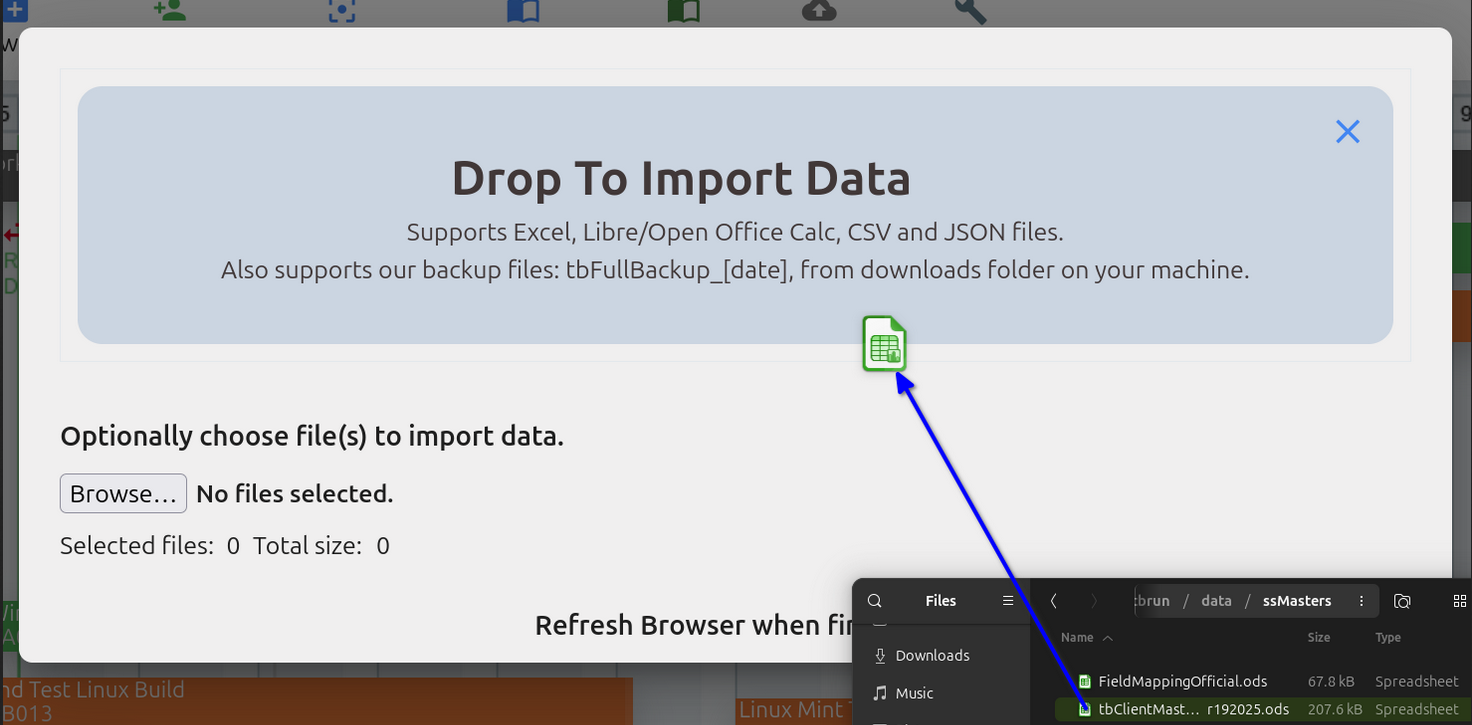
The quickest way to set up a project in Timebars is through the spreadsheet template. Download it from the menu, populate the Resources tab with resource names, roles, rates, and skills, then add your work packages and tasks on the Projects tab. Drag the completed spreadsheet onto the Timebars canvas and the entire structure imports in seconds — hierarchy, resources, metadata, and all.
The same template is used for export. Pull current project data back out whenever you need an offline copy, want to share data with someone without a licence, or need to run custom analysis in Excel. Changes made in the spreadsheet can be re-imported without losing data already on the canvas. For organisations that live in spreadsheets, this is the feature that makes Timebars feel like a natural extension of existing processes rather than a replacement for them.
The bridge between the way your team works and the tool.
Show in Reports
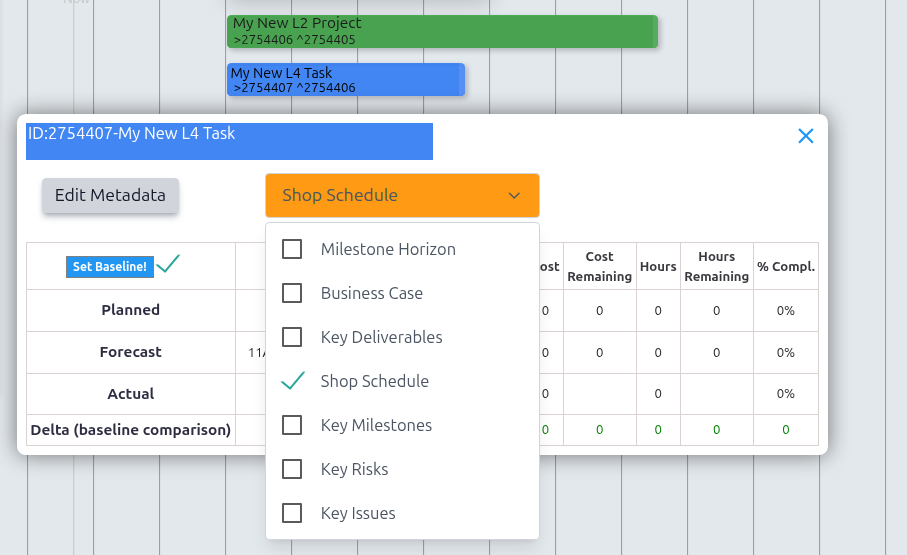
Every task bar and milestone diamond carries a picklist that controls which reports that item appears in. Rather than including every scheduled item in every view, project managers can tag each bar precisely — selecting whether it surfaces in the local project reports, the Personal Dashboard, or the Enterprise Dashboard. This gives teams the ability to curate what stakeholders and individuals see in their reports without altering the underlying project structure, keeping dashboards focused and relevant rather than cluttered with every task in the portfolio.
The Facilities report demonstrates the power of this approach. Bars tagged for Facilities are pulled from across multiple projects and rendered together on a single Gantt chart, giving a consolidated visual of every facility booking regardless of which project raised it. A training room, a test environment, a piece of specialist equipment — any resource that is shared across project boundaries can be tracked this way, with clashes and availability visible at a glance. The report framework is extensible, so organisations can define additional report categories that match their own operational needs beyond the built-in defaults.
Tag once. Appear in exactly the right reports.
Report Menu
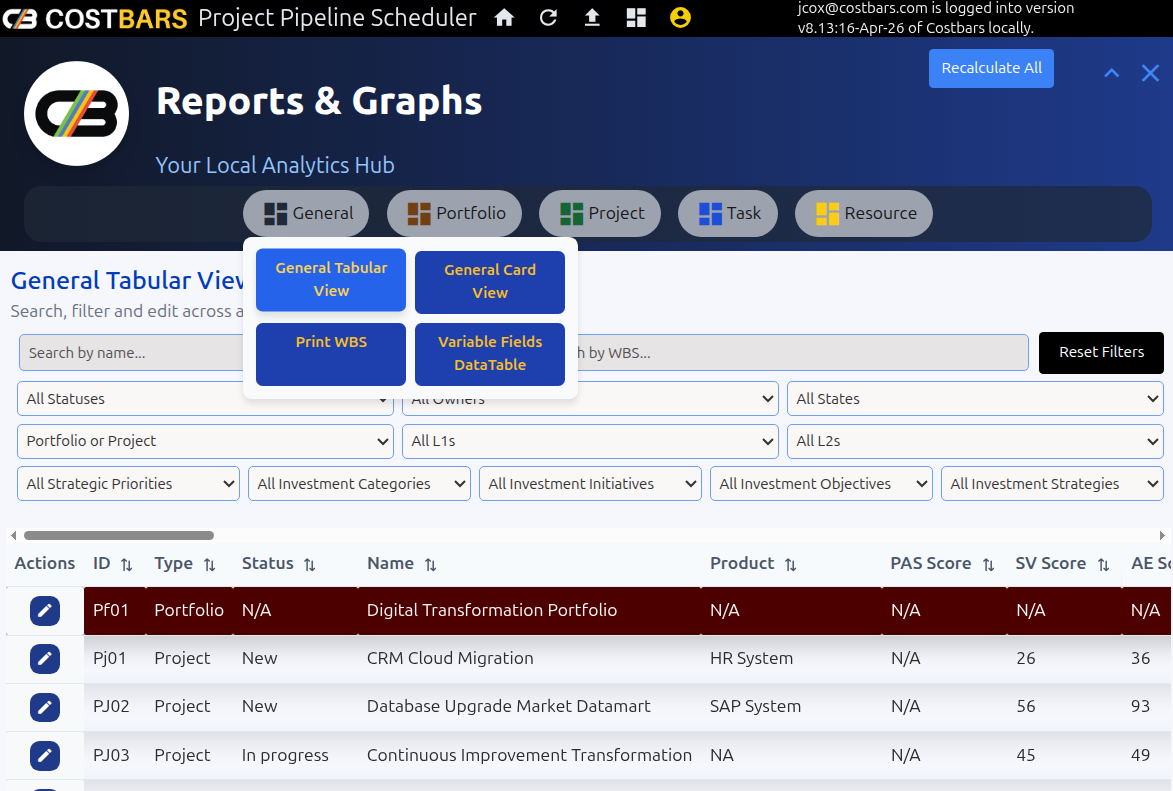
The Report Menu is your local analytics hub, bringing together every report and graph available within the application into a single organised navigation panel. Five report categories cover the full breadth of project data: General overviews for high-level summaries, Portfolio views for cross-project analysis, Project-level reports for schedule and cost detail, Task reports for granular progress tracking, and Resource reports for capacity and utilisation analysis. Each category surfaces the metrics most relevant to that level of the hierarchy, so whether you are presenting to a steering committee or drilling into an individual work package, the right view is one click away.
All reports are generated from the project data on your local canvas — no data leaves the application and no connection to an external reporting service is required. Charts and graphs update to reflect the current state of your projects, giving you analytics that are always in step with the plan rather than dependent on a scheduled export or a manual refresh. For project managers who need to communicate status quickly, the Report Menu turns the data already in the tool into presentation-ready outputs without additional effort.
Every chart, every metric, every level — one menu.
Personal Dashboard
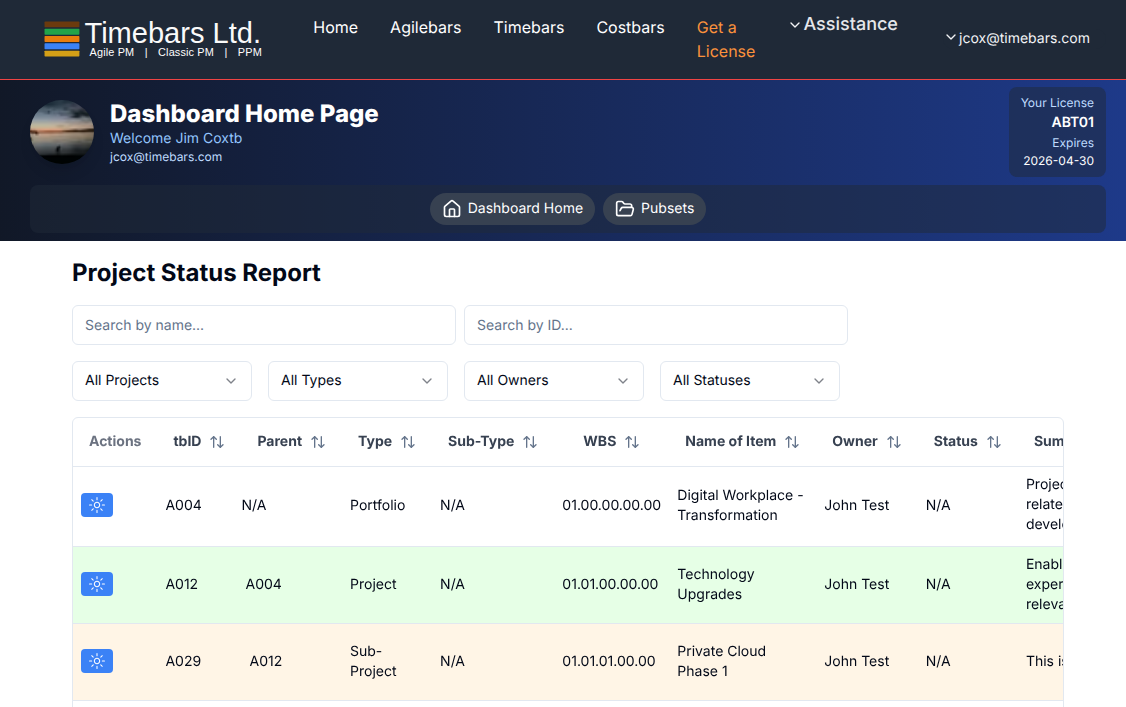
The Personal Dashboard gives every user a single screen that cuts straight to what matters to them. At a glance you can see every task you own across all active projects, their current status, progress percentages, and upcoming deadlines — without having to open individual project plans or ask a project manager for an update. Your work is presented cleanly, ranked by priority and due date, so you start each day knowing exactly where to focus.
Unlike portfolio views designed for managers, this screen belongs to the individual. Overdue items surface automatically at the top, colour-coded so critical slippage is impossible to miss. As you complete work and update progress, the dashboard reflects the change immediately — giving you a real-time record of your own contribution across the organisation's entire project portfolio. No separate task list, no email chains, no status meetings needed just to know where you stand.
Your workload, your deadlines, your status — one screen.
Browser-Based, No Installation Required
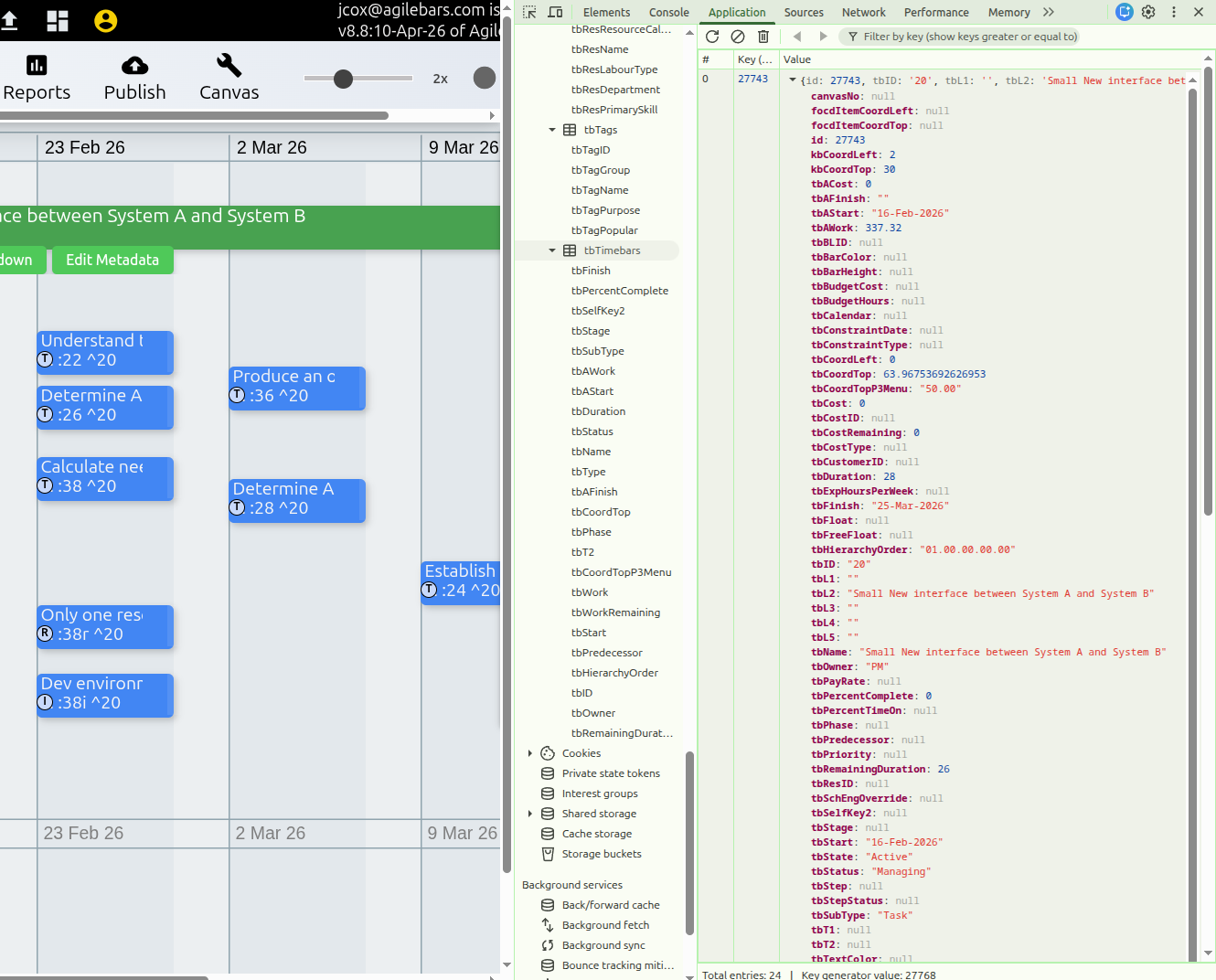
All three applications run entirely in the browser — accessed from a URL like any web page, with nothing to install, configure, or maintain on the user's machine. There is no client software to deploy, no IT ticket to raise, and no version to keep up to date. Open the link, sign in, and your full project environment is available immediately on any modern browser, on any device, without touching the operating system beneath it.
Project data is stored directly in the browser's built-in IndexedDB — a structured local database that holds your schedules, resources, and metadata entirely on the machine in front of you. Nothing is written to a shared cloud server. That means your data stays within your own environment: behind your firewall, on your hardware, under your control. For organisations with strict data governance requirements or sensitive project information, this is the architecture that makes adoption straightforward where cloud-hosted tools cannot go.
Your data stays on your machine. Always.
AI Project Creator
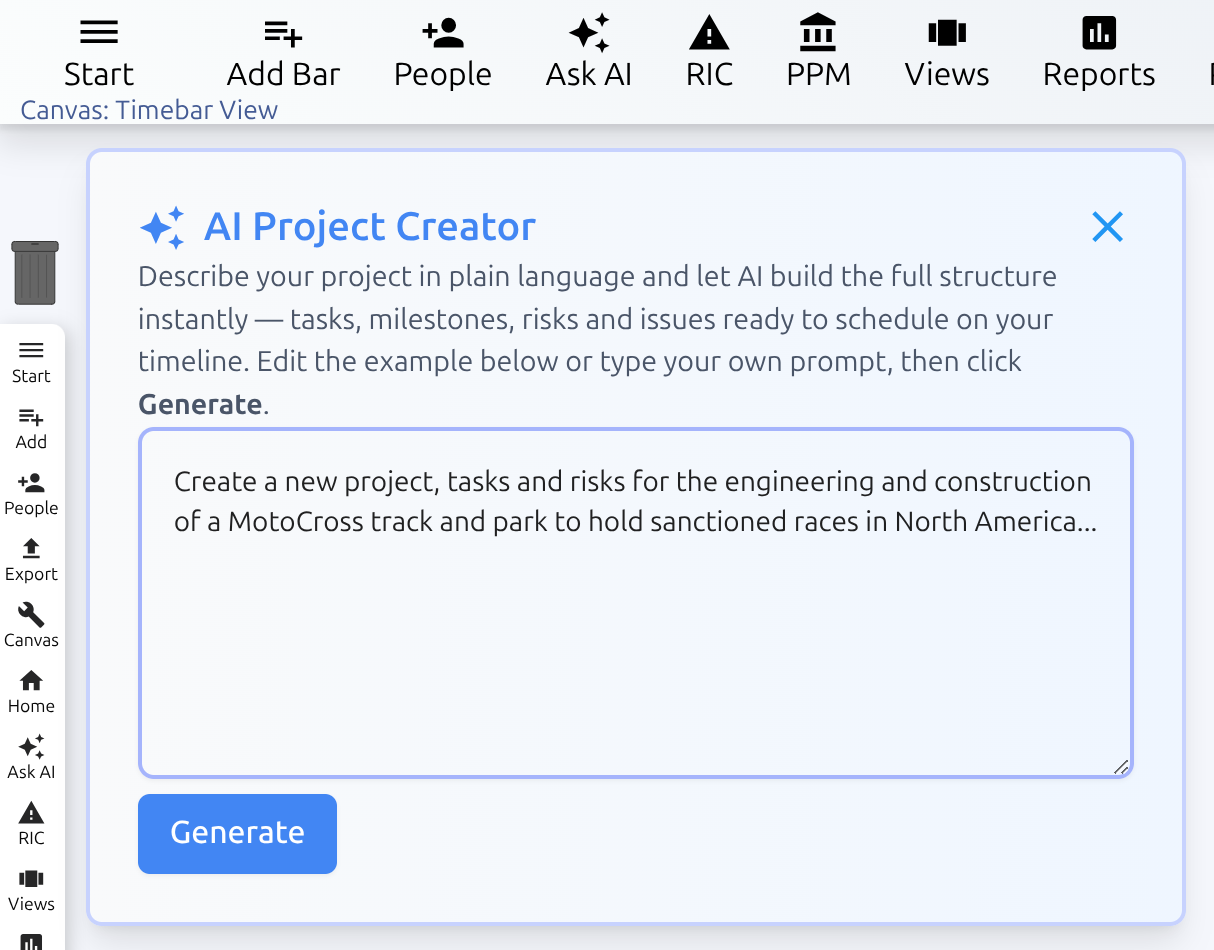
Describe your project in plain language and the AI builds a complete, ready-to-schedule structure in seconds. Type a brief outline — the objective, the key deliverables, any known constraints — and the generator produces a full hierarchy of tasks, milestones, risks, and issues, populated with realistic durations and logical sequencing. The result lands directly on your timeline, already structured and ready for resource assignment, with no blank-canvas starting point and no manual data entry to wade through.
The generated plan is a starting point, not a final answer. Every task, date, and dependency it creates is fully editable — drag bars, adjust durations, promote or demote items in the hierarchy exactly as you would with any manually built project. For project managers scoping a new engagement, the AI creator compresses hours of initial setup into a conversation. For teams running repeatable project types, it produces a consistent first-draft structure that can be refined rather than rebuilt from scratch each time.
From a sentence to a scheduled project plan in seconds.
AI Help Assistant
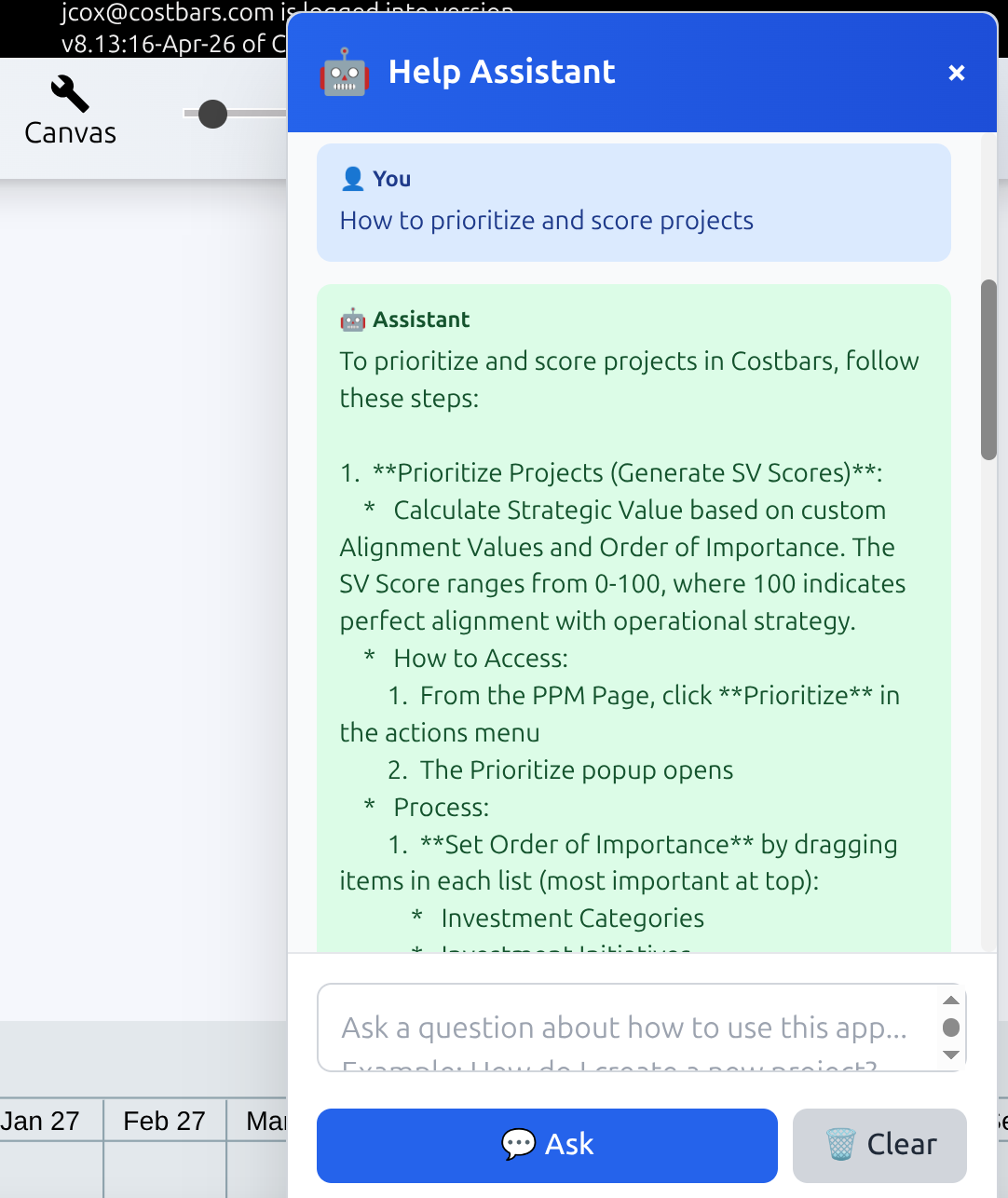
The built-in Help Assistant puts the entire application knowledge base at your fingertips, powered by Google Gemini. Every help article, feature guide, and workflow explanation has been integrated directly into the AI model, so when you ask a question you get an answer that is specific to this application — not a generic response drawn from the open web. Ask how to set a baseline, how to configure a custom field, or how dependencies behave when a constraint is applied, and the assistant responds with accurate, contextual guidance drawn from the same documentation the support team uses.
The assistant is available without leaving your current view, so you never lose your place in a planning session to go searching through help pages. Type a question in plain language — as you would ask a colleague — and get a direct, actionable answer in seconds. For new users getting up to speed, it replaces the need to read documentation cover to cover. For experienced users hitting an unfamiliar corner of the application, it is faster than any search index. The more specific your question, the more precise the answer.
Ask anything. Get answers from someone who knows the app.
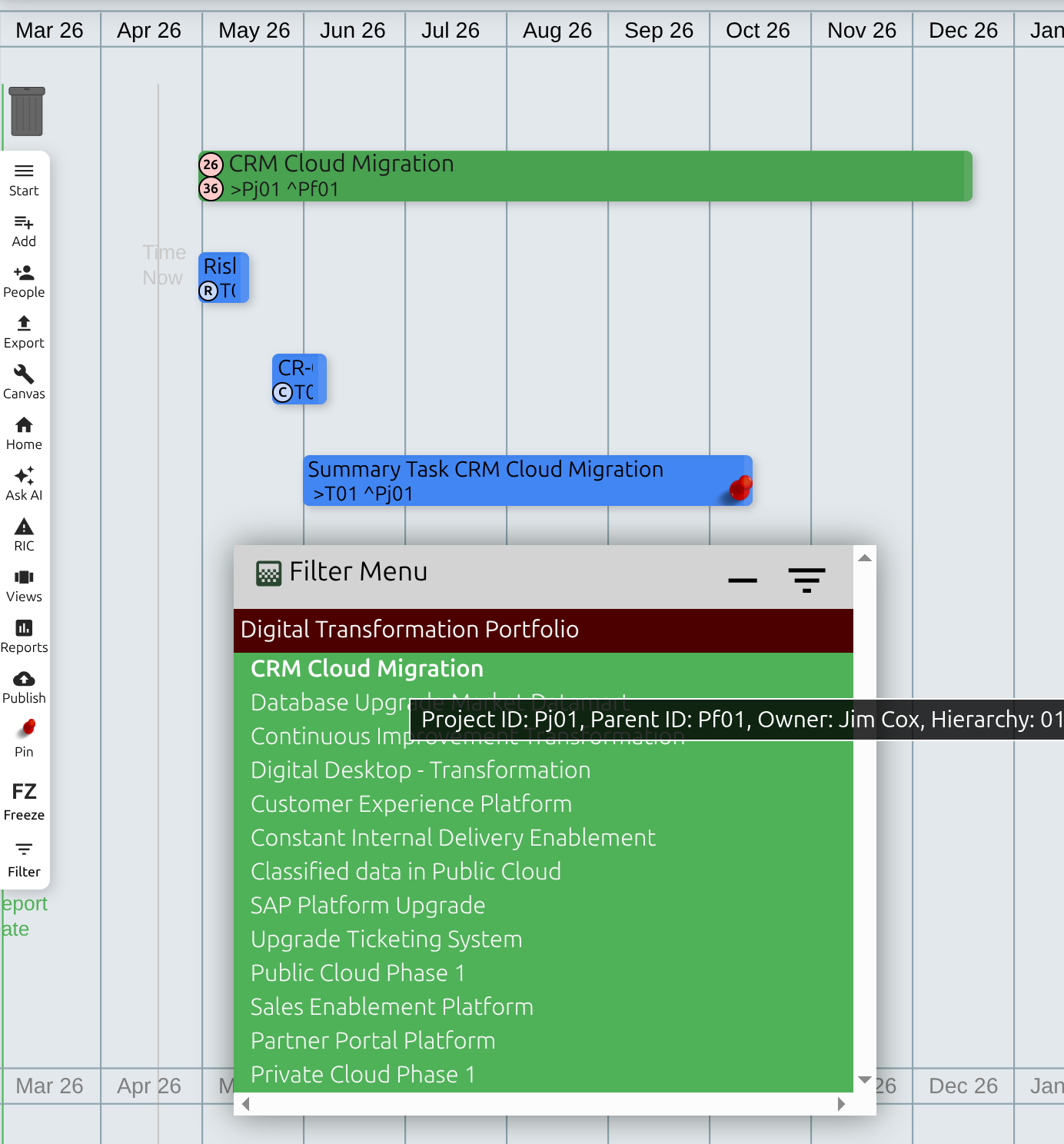
Filter Menu
The Filter Menu gives you precise control over what is visible on the canvas at any moment. Accessed via the pink FM tab on the left-hand edge of the timeline, it renders your project hierarchy as a set of clickable hyperlinks — L1 portfolio groupings in brown, L2 projects in green, and L3 work packages in orange. Click any level to apply a filter instantly, stripping away everything above and below it so the canvas shows only the bars you need to work with. When the full portfolio view becomes too dense to navigate, the Filter Menu is how you cut through the noise.
Filters are persistent. The application remembers the last level you selected, so when you return to the canvas it opens exactly where you left off — filtered view intact, no need to re-navigate to your working project each session. Collapse the menu with the FM tab to reclaim canvas space when you no longer need it, and bring it back in one click when you do. For Agilebars users the menu operates at the single project level, giving sprint teams the same focused view within their own simplified two-tier hierarchy.
Cut the canvas down to exactly what you need to see.
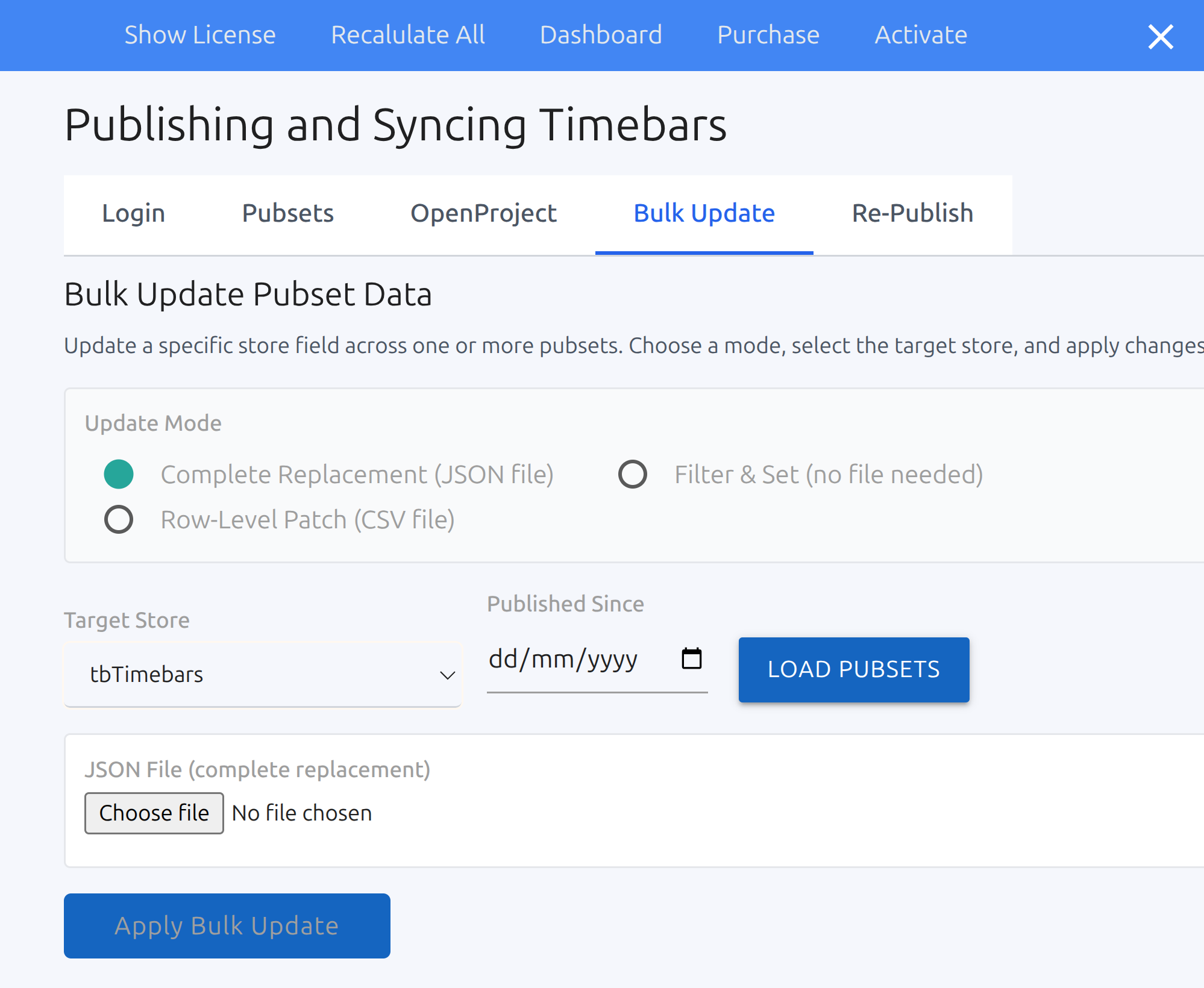
Bulk Update Form
The Bulk Update Form is available on the Publishing page and lets you apply a field change across multiple pubsets in a single operation. Choose the update mode, select the target store, define the value to apply, and confirm — the change propagates across every selected pubset immediately, without opening each one individually. Whether you are correcting a status field that was set incorrectly across a programme of projects, updating an owner after a team change, or resetting a metadata value at the end of a reporting period, bulk update turns a repetitive manual task into a single form submission.
The form is deliberately focused: one field, one value, one operation at a time. That constraint is what makes it safe to use across large numbers of pubsets without risk of unintended side effects. Select your target store carefully, preview what will be affected, and apply with confidence. For administrators managing a large project portfolio, this is the tool that keeps data consistent across the estate without requiring individual project managers to make the same change in each of their own plans.
One change. Every pubset. Done.
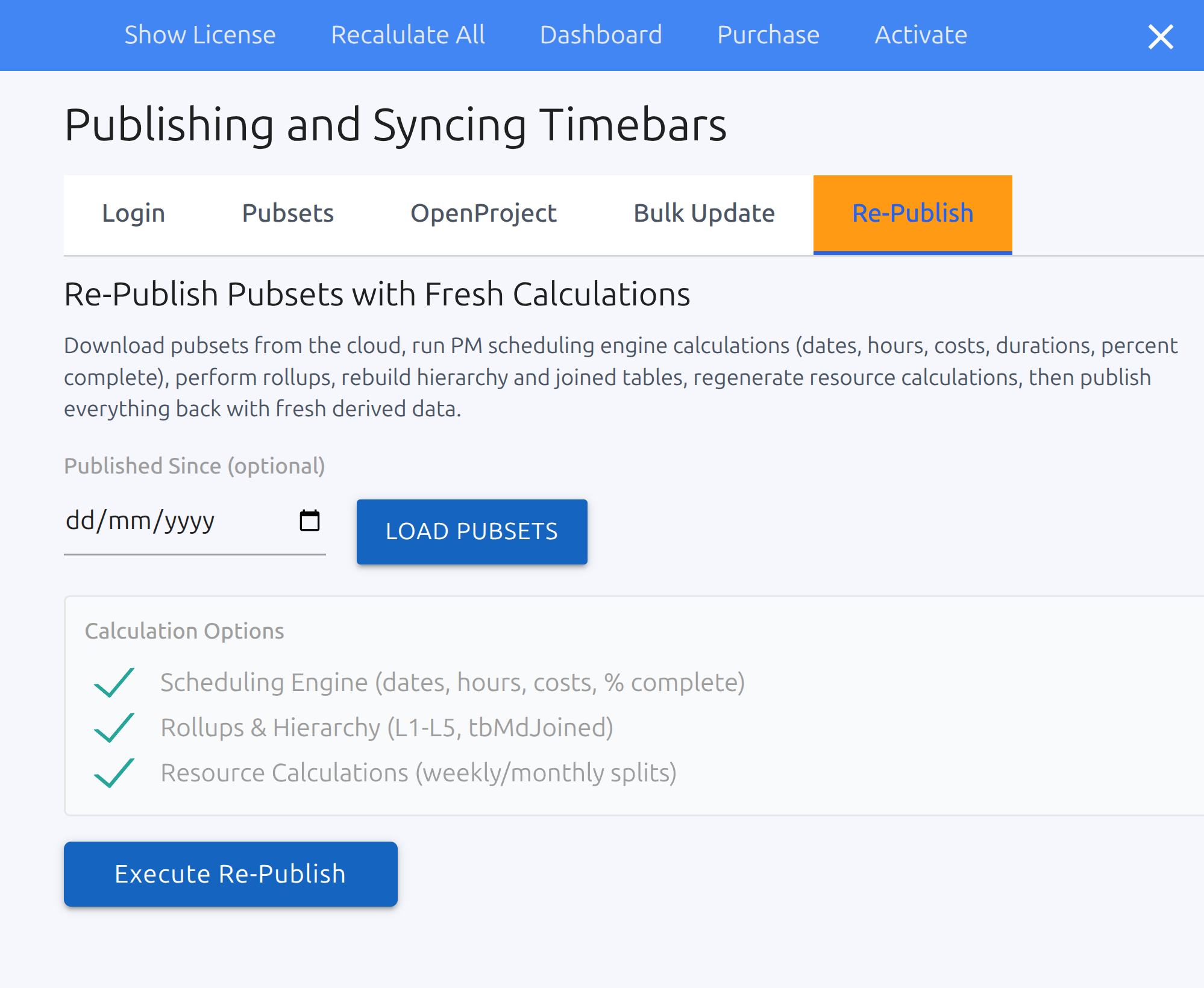
Re-Publish with Fresh Calculations
The Re-Publish form triggers a full recalculation cycle across your selected pubsets and pushes the results back to the cloud in one operation. Every derived value is recomputed from source: the scheduling engine recalculates dates, hours, costs, and durations; rollups are rebuilt from task level through to portfolio; the hierarchy and joined tables are reconstructed; and resource calculations are regenerated from current allocation data. The published dataset that emerges reflects the true current state of the portfolio — not a snapshot from the last time someone manually saved a project.
This is the tool to reach for when source metadata changes in a way that affects calculated values across multiple projects simultaneously. A rate change to a resource pool, a revision to working calendars, or an update to a custom field that feeds downstream calculations — rather than opening and republishing each affected project individually, a single Re-Publish run processes the entire selection and restores consistency across the estate. The operation is repeatable and auditable, giving administrators confidence that the data visible to stakeholders and dashboards is always derived from the same calculation rules.
Stale derived data, corrected across every project at once.
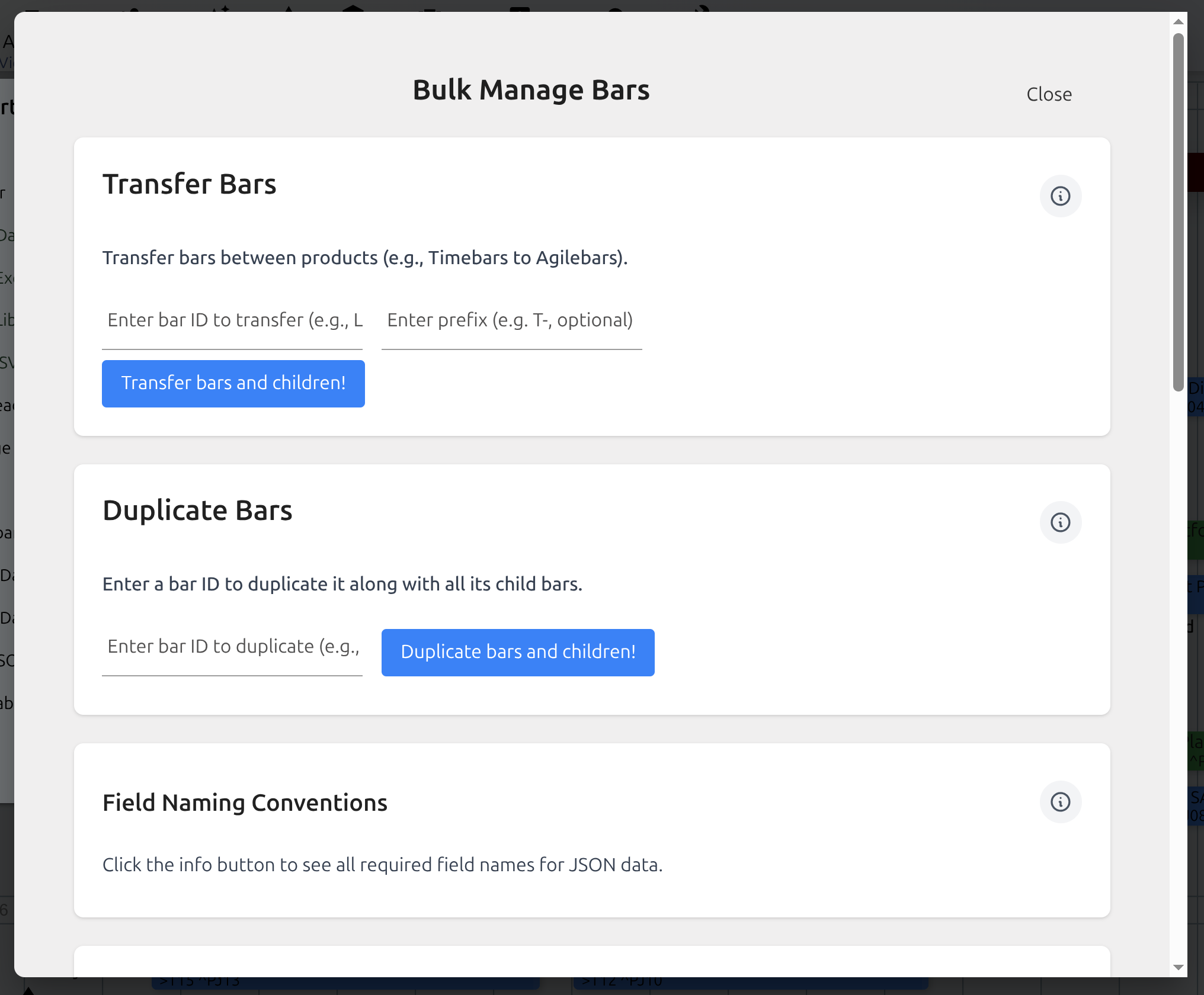
Bulk Manage Bars
The Bulk Manage Bars form gives administrators and project managers the ability to manipulate project structures at scale without touching the canvas directly. Transfer bars between projects to restructure a portfolio after a reorganisation, duplicate entire work packages to use a proven task structure as the foundation for a new project, or create bars in bulk by importing structured data from JSON or CSV. Operations that would take considerable time bar-by-bar on the canvas are resolved in a single form submission.
The import path from JSON and CSV is particularly useful for organisations that generate project structures from external systems — contract management tools, bid management software, or planning templates maintained outside the application. Rather than manually recreating that structure on the canvas, feed the data directly into the form and the bars are created with hierarchy, metadata, and sequencing intact. Combined with the duplicate and transfer functions, the Bulk Manage form gives you the full toolkit for keeping a large, evolving project portfolio organised without disruptive manual rework.
Restructure, duplicate, and build at scale — not one bar at a time.
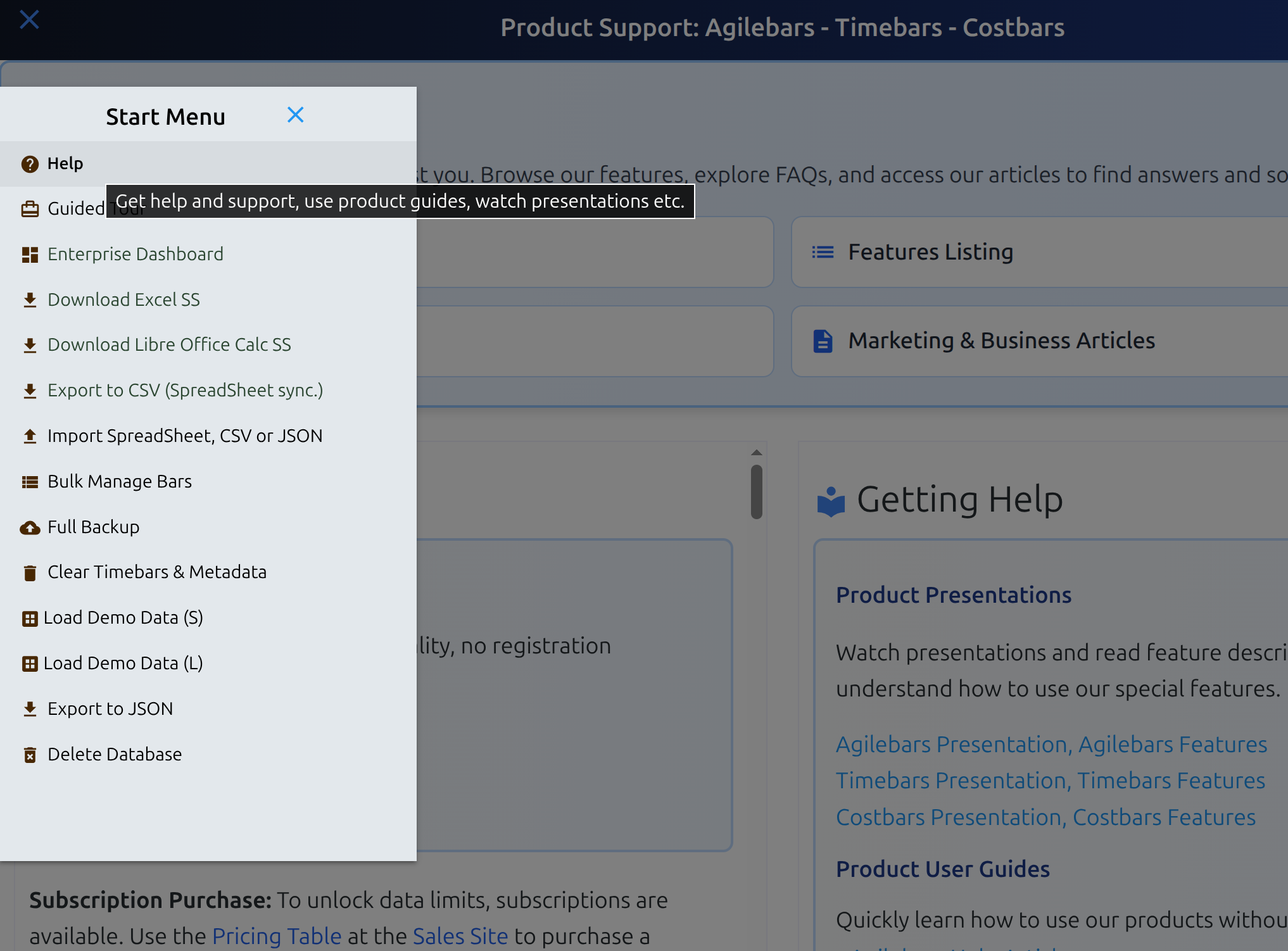
Help & Support Resources
Every application links directly to a full suite of support resources, accessible whenever you need them without leaving your workflow. The Help section brings together feature documentation, frequently asked questions, and a library of articles covering everything from first-time setup through to advanced configuration. Whether you are a new user building familiarity with the interface or an experienced manager tracking down the specifics of a particular behaviour, the answers are organised and searchable without needing to raise a support ticket.
The resources are maintained alongside the application itself, so documentation reflects the current version of the product rather than lagging behind it. Feature guides walk through each area of the application with practical context, FAQ entries address the questions the support team hears most often, and articles cover common workflows, best practices, and integration scenarios in depth. For teams rolling out the application across an organisation, the Help section is the first place to direct new users — reducing onboarding time and keeping the support burden manageable as adoption grows.
Answers at hand, whenever the question arises.
Enterprise Dashboard
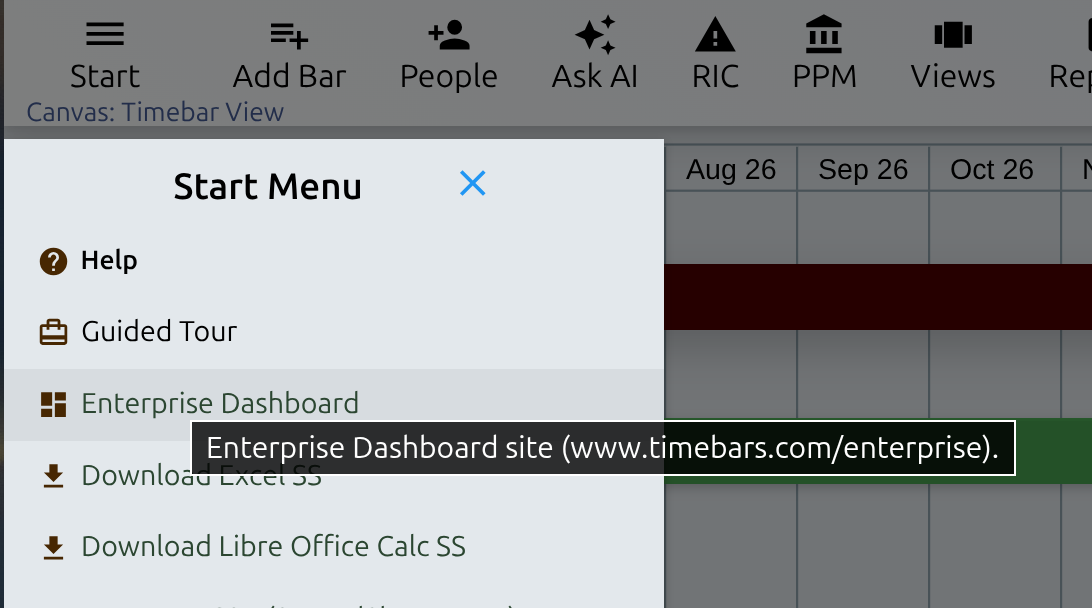
The Enterprise Dashboard consolidates data from multiple pubset sources into a single analytical environment, giving senior managers and portfolio leads a unified view across the entire organisation. Rather than reviewing projects one at a time, the dashboard aggregates published data and presents it across dedicated analytical lenses: Project status and progress, Facilities and physical resource utilisation, Resource capacity and demand, Agile sprint performance, and Portfolio & Programme Management metrics. Each view draws from the same underlying pubset data, so figures are consistent regardless of which lens you are looking through.
Access is personalised — the dashboard recognises the signed-in user and surfaces the consolidated data relevant to their portfolio scope. The Settings menu allows administrators to configure data sources, adjust display preferences, and control which pubsets feed each view. For executives and programme directors who need to answer questions about the state of the portfolio without drilling into individual project plans, the Enterprise Dashboard is where that conversation starts — reliable, consolidated, and always reflecting the latest published data.
Every project. Every resource. One dashboard.
OpenProject Integration
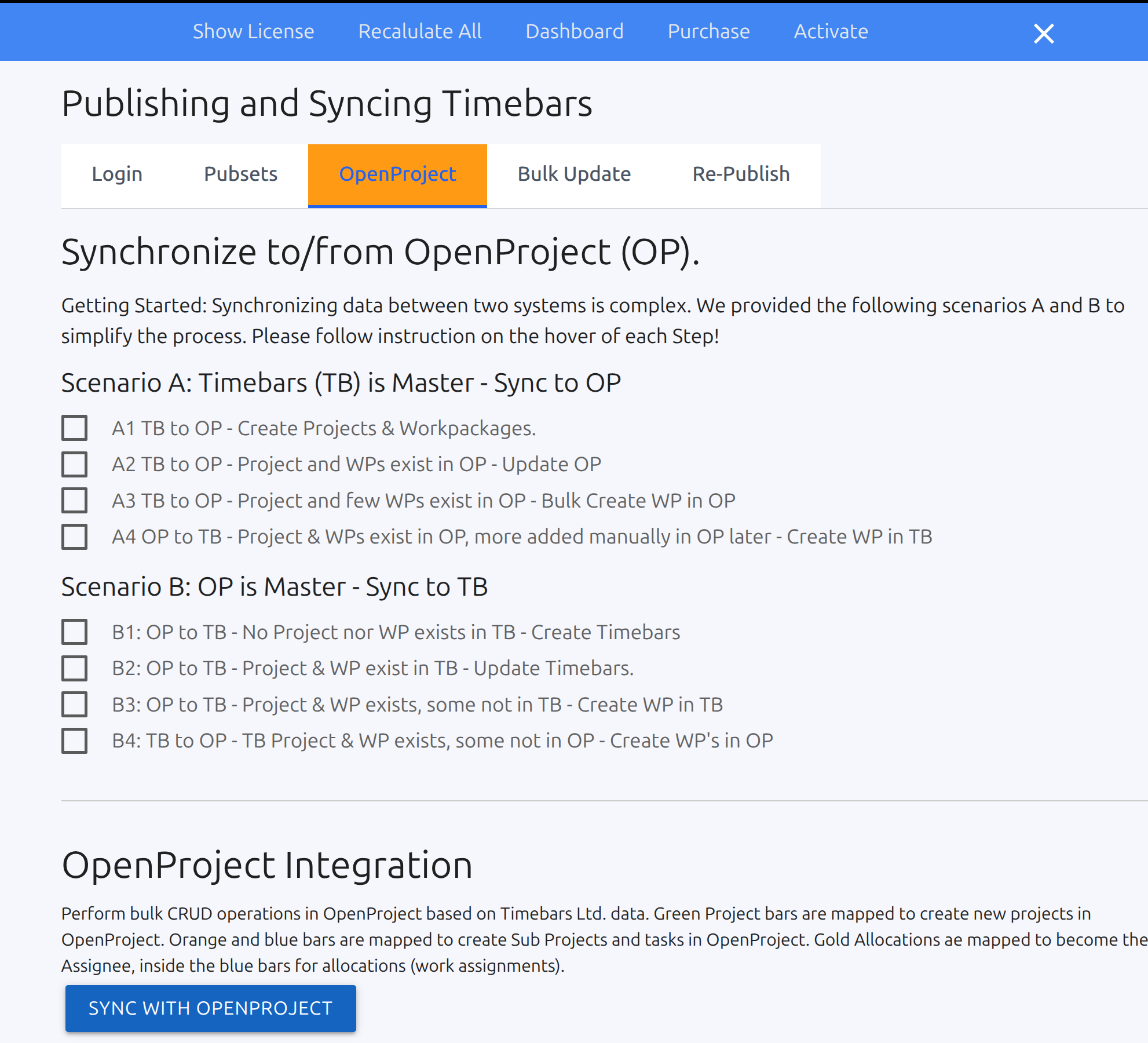
The OpenProject integration creates a live synchronisation bridge between the application and your OpenProject instance, allowing data to flow in both directions without manual export and re-import cycles. Project structures, tasks, assignments, and progress updates maintained in either system can be kept in alignment, so teams working in OpenProject and portfolio managers working in the scheduling canvas are always looking at the same underlying data. The integration is designed for organisations that run OpenProject for team-level execution while using Timebars, Agilebars, or Costbars for portfolio-level planning and reporting.
Because synchronising two live systems carries complexity, the integration is structured around two guided scenarios — Scenario A and Scenario B — that cover the most common setup patterns. Each scenario walks through the required steps in sequence, with hover instructions on every step explaining exactly what to do and why. Follow the scenario that matches your setup, work through the steps in order, and the synchronisation is configured correctly without needing to understand the underlying API mechanics. For administrators setting this up for the first time, the scenario framework removes the guesswork and gets both systems talking reliably.
Two systems, one source of truth.
Text Notifications
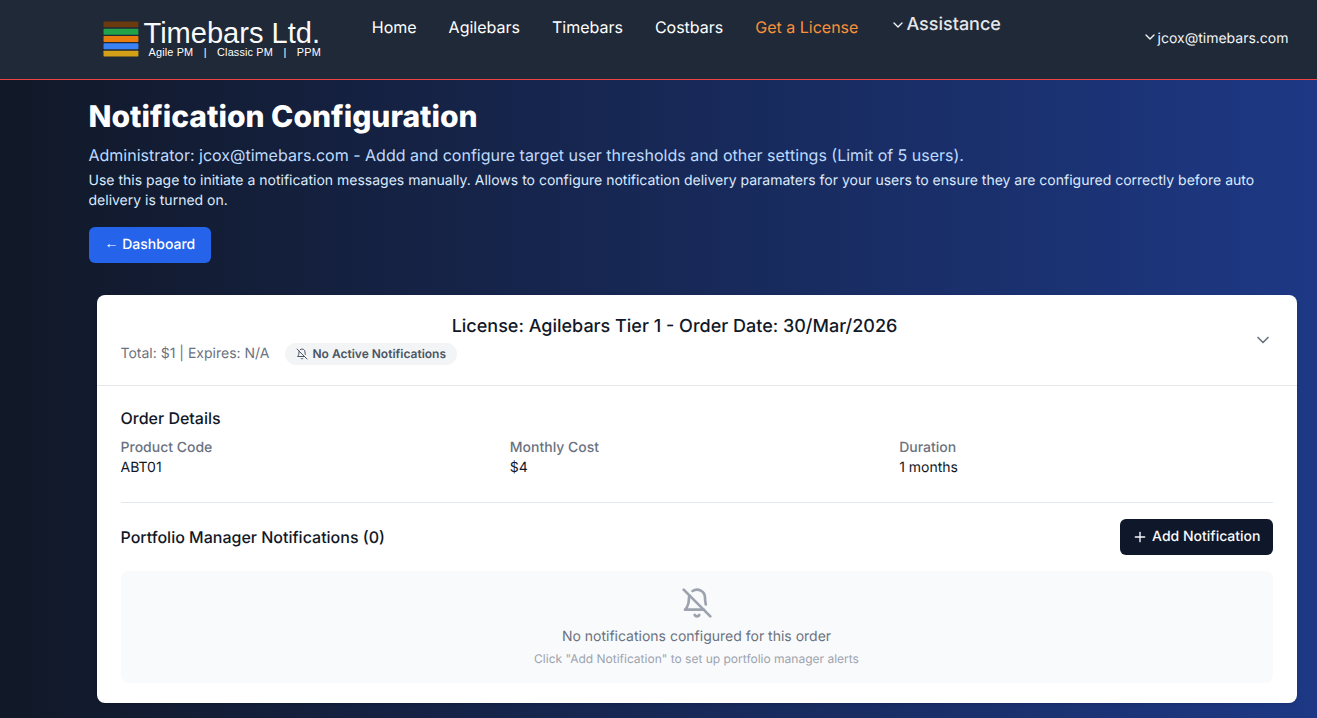
The Notifications system allows administrators to configure automated text message delivery to up to five target users, with thresholds and delivery parameters set individually for each recipient. Each user's notification profile defines what triggers a message, at what threshold values, and through which delivery channel — giving precise control over who gets alerted, when, and under what project conditions. Configuration is handled centrally by the administrator, so notification behaviour is consistent and governed rather than left to individual users to set up themselves.
Before enabling automatic delivery, the manual send function lets administrators initiate a test notification to verify that delivery parameters are configured correctly for each user. Send a message, confirm receipt, adjust the settings if needed, and only then turn on automated delivery — eliminating the risk of silent failures or misconfigured alerts reaching users at the wrong time. For organisations where timely escalation of project thresholds is business-critical, this is the tool that ensures the right people are informed the moment a trigger condition is met.
The right alert, to the right person, at the right threshold.
Included in every product
A Shared Platform Across the Entire Suite
Whether you run Agilebars, Timebars, or Costbars, the following management capabilities and supporting systems come built in — no extras to bolt on, no separate modules to purchase.
Additional Management Features
Risks, Issues & Change Requests
Track risks, issues, and formal change requests directly on the project canvas. Each type carries its own colour-coded indicator and severity level, with a dedicated form for owner, mitigation, status, and resolution notes. Critical items surface immediately — no separate register required.
Supply & Demand Grids
See resource supply against project demand in a time-phased grid. Each column shows exactly how much capacity is consumed per period, making it straightforward to spot shortfalls, overallocation, and idle capacity before they affect delivery.
Local Reports & Graphs
Generate charts and reports directly within the application — no export to a separate BI tool. Schedule variance, cost performance, resource utilisation, and progress summaries are all available from the built-in reporting engine, ready to print or share.
Enterprise Dashboard
Publish project data to a secure cloud dashboard accessible to anyone in your organisation with the right role. Executives and governance boards can view live charts, progress summaries, and risk indicators from any browser without needing access to the tool itself.
Personal Dashboard
Each team member gets a personal view filtered to their own assignments, deadlines, and resource commitments. The personal dashboard cuts through portfolio noise so individuals can focus on what they are responsible for without losing sight of the bigger picture.
Strategic Texting (Phone)
Receive SMS alerts on your mobile when projects cross critical thresholds — schedule slippage, budget overrun, or risk escalation. Stay informed without being chained to a desktop or logged into the application.
Supporting Systems
Custom Fields, Picklists & Tagging
Define your own metadata fields, picklist values, and tags through the spreadsheet Tags Table. These flow through every form, filter, and report in the application, ensuring your data matches your organisation's terminology rather than forcing you into a pre-set schema.
Spreadsheet Sync
Import and export all project data using Excel, LibreOffice Calc, or OpenOffice Calc templates. Drag the spreadsheet onto the canvas to import; pull data back out at any time for offline use, sharing, or custom analysis. The round-trip is lossless.
Cloud Publishing & Role-Based Access
Control exactly who sees which project data by publishing with role-based permissions. Publish summary data for executives, detailed task data for project teams, and risk registers for governance — each audience sees what they need and nothing more.
Ask AI for Help
An AI assistant is built directly into every product. Ask it to explain scheduling concepts, suggest risk mitigations, interpret charts, or walk you through any feature in plain language. No separate AI subscription required — it is part of the platform.
Ask AI to Create Projects & Business Cases
Describe a project in plain language and let the AI generate a structured plan — work packages, tasks, milestones, resource requirements, and a business case summary — ready to review and import onto the canvas. Dramatically reduces the time spent on initial project setup.
FOCD Forms
Formal Change Order and Decision forms capture approved scope changes, schedule adjustments, and key decisions in a structured, auditable record. Each form links directly to the affected items on the canvas, maintaining full traceability between decisions and the live plan.

Timebars Resource Scheduler
Visualize and manage your projects and resources with ease.